
By the Sunfinity Power and Roofing Team
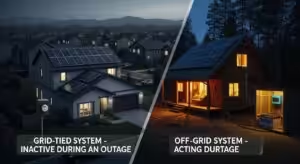
During a power outage, a standard grid-tied solar system shuts off automatically, even on a bright sunny day. That is a safety requirement, not a defect: it keeps your panels from sending electricity into downed lines where utility crews are working. If you want your lights, refrigerator and heat to stay on when the grid goes down, you need solar paired with a home battery (or a backup generator) and the right inverter and switching equipment. With that setup, your home separates itself from the grid within moments, runs on stored energy, and recharges from the sun the next morning.
This guide explains exactly what happens to solar panels in a blackout, the options New England homeowners have for backup power, how long a battery can carry your home through a storm, and how Rhode Island, Massachusetts and Connecticut homeowners can make storage more affordable in 2026.
Why Grid-Tied Solar Panels Shut Off During a Blackout
Most homes with solar in New England are grid-tied. The panels make electricity during the day, your home uses what it needs, and any extra flows out to the utility grid in exchange for net metering credits. At night or on cloudy days, you pull power back from the grid.
The tradeoff shows up when the grid goes down.
Anti-islanding protection
Every grid-tied solar inverter is built to detect when utility power disappears and stop sending electricity within a fraction of a second. This is called anti-islanding protection, and utilities require it before they will let any system connect. The reason is simple: when a storm knocks down a line, line crews need to know that the wires they are repairing are dead. If thousands of solar homes kept pushing power onto the lines, those crews could be seriously hurt.
Why the panels cannot just power your house directly
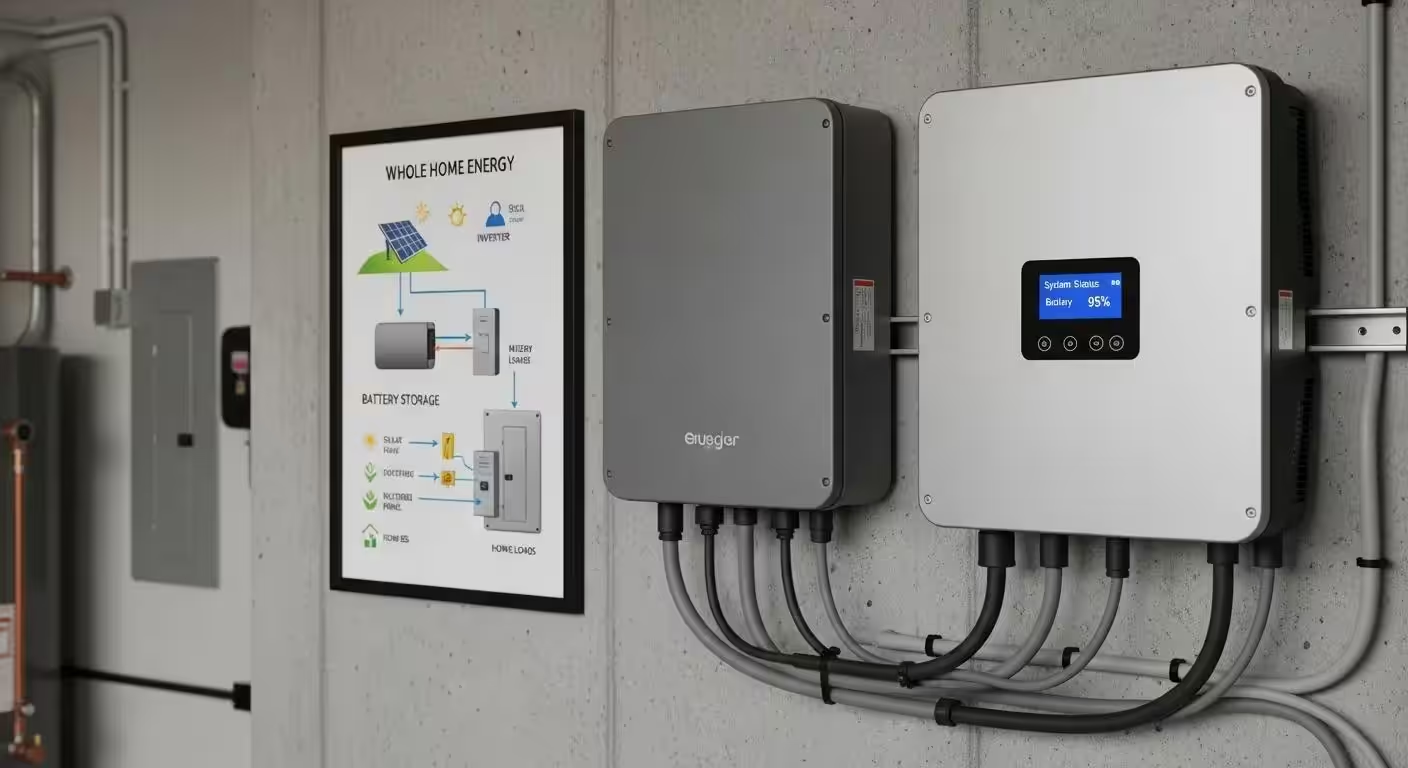
Homeowners often ask why the inverter cannot simply disconnect from the street and keep feeding the house. A standard grid-tied inverter has no way to do that on its own. It needs the grid as a reference signal to operate, and it has nothing to smooth out the mismatch between what the panels produce second by second and what your appliances demand. A passing cloud or your well pump kicking on would cause the voltage to swing wildly. To run your home safely in an outage, the system needs two extra pieces:
- A way to isolate your home from the grid. This is usually an automatic transfer switch or a backup gateway that physically disconnects your house from utility lines when the power fails.
- A stable power source to form a local “mini grid.” A battery with a compatible inverter does this job. It holds voltage steady and covers the gaps when solar production rises and falls.
What this means if you already have solar
If you have panels today but no battery, your system almost certainly goes dark in an outage. Your panels are fine and your net metering credits are unaffected. You simply have no power until the utility restores service. Many existing systems can add a battery later.
Your Backup Power Options Compared
There are four common ways New England homeowners set up solar with outages in mind. The right choice depends on how often you lose power, what you need to keep running, and how long outages tend to last on your street.
| Setup | Power during an outage? | Recharges from sun? | Best for | Main limitation |
|---|---|---|---|---|
| Grid-tied solar only | No | Not applicable | Homeowners focused on lowering electric bills | No backup power at all |
| Solar plus battery | Yes, automatically | Yes | Most homes that want quiet, automatic backup and incentive eligibility | Run time depends on battery size and season |
| Solar plus standby generator | Yes, from the generator | No, solar stays off unless a battery is added | Homes needing multi-day whole-home backup in any weather | Fuel, noise, maintenance and emissions |
| Off-grid solar | Always independent | Yes | Remote properties without utility service | Large battery bank, no net metering, usually a generator still needed in winter |
For most homes in Rhode Island, Massachusetts and Connecticut, solar plus a battery is the sweet spot. It keeps the financial benefits of net metering, adds automatic backup, and opens the door to state storage incentives that a generator does not qualify for.
How Solar Plus Battery Backup Works in an Outage
When a storm takes down power on your street, here is what happens in a properly designed solar and battery system:
- The grid fails. The system’s gateway or transfer switch detects the loss of utility power.
- Your home disconnects from the grid. The switch opens, isolating your house so no power can flow out to the lines.
- The battery takes over. Within moments, often fast enough that clocks and Wi-Fi routers keep running, the battery begins powering your backed-up circuits.
- Solar keeps working. With a stable local grid formed by the battery, your panels turn back on, power your home during the day, and recharge the battery with any extra.
- The grid returns. The system confirms utility power is stable, reconnects, and goes back to normal operation automatically.
You do not have to flip switches, start an engine or run extension cords.
Partial home backup vs whole-home backup
One of the biggest design decisions is which circuits the battery powers during an outage.
- Essential loads backup. The installer moves your most important circuits, such as the refrigerator, heating system controls, well pump, sump pump, some lights and outlets, and internet, to a dedicated backup panel. The battery only powers that panel, which stretches your stored energy much further.
- Whole-home backup. The battery system backs up your entire main panel. This is more convenient, but large loads like central air conditioning, electric ranges, electric dryers and electric water heaters can drain a battery fast. Whole-home designs usually need more battery capacity and sometimes load management devices that keep big appliances from running at the same time.
Some homes also need electrical work to make either option possible. Our guide on electrical panel upgrades for solar explains when an older panel needs attention.
The inverter matters
Not every solar inverter can work with a battery in backup mode. Systems are generally set up in one of two ways:
- DC-coupled: the panels and battery share a hybrid inverter. This is common in new installations that include storage from the start.
- AC-coupled: the battery has its own inverter and connects alongside your existing solar inverter. This is often the simplest way to add storage to a system that is already on your roof.
For a deeper look at the equipment side, see our article on string inverters vs microinverters.
How Long Will a Solar Battery Power Your Home?
There is no single answer, because run time depends on how much energy your battery stores, what you are running, and how much sun you get during the outage. A small battery powering only essentials can often stretch across a day or more, and with decent sun it can recharge and keep going for many days. The same battery trying to run central air, an electric range and a dryer might last only a few hours.
What drives battery run time
- Battery capacity. Measured in kilowatt-hours (kWh). More capacity means more stored energy. Many homes use more than one battery unit.
- What is connected. Essential-loads backup lasts far longer than whole-home backup.
- How you behave during the outage. Running the dishwasher at noon when the panels are producing, and keeping big loads off at night, makes a real difference.
- Season and weather. A sunny June outage is very different from a January outage after a nor’easter dumps snow on your panels.
- Heating type. Oil and gas systems only need power for blowers, pumps and controls. Homes heated by electric heat pumps need much more stored energy to stay warm.
Prioritizing what to back up
When we design a backup system, we start with what you truly cannot be without. This table shows how we typically think about common household loads.
| Load | Priority | Why it matters in an outage | Battery impact |
|---|---|---|---|
| Refrigerator and freezer | High | Prevents food loss in multi-day outages | Low to moderate |
| Well pump | High (if you have a well) | No power means no water for drinking, flushing or washing | Moderate in short bursts |
| Sump pump | High (if you have one) | Storms that cause outages often bring heavy rain and flooding | Moderate in short bursts |
| Furnace or boiler controls and blower | High in winter | Oil and gas heat will not run without electricity | Low to moderate |
| Medical equipment | Critical | CPAP machines, oxygen concentrators and similar devices | Usually low |
| Internet, phones and lighting | High | Communication, safety and outage updates | Low |
| Heat pumps | Depends on home | Primary heat or cooling for many electrified homes | High |
| Central air, electric range, dryer, water heater | Lower | Comfort and convenience | High |
Once we know your priority loads and your actual usage from past electric bills, we can size the battery to match. Our guide on what size solar system you need walks through the same thinking for the panels themselves.
Power Outages in New England: What to Plan For
Nor’easters and winter storms
Heavy wet snow and ice bring down limbs and lines across Rhode Island, eastern Massachusetts and Connecticut every winter. These outages are the toughest test for solar backup because the panels may be covered in snow and daylight hours are short. Panels shed snow faster than most people expect once the sun comes out, and our article on solar panel performance in snow covers what to expect. Still, for winter outages it is smart to assume the battery will be doing most of the work for the first day or two and size essential loads accordingly.
Tropical storms and summer thunderstorms
Late summer and fall tropical systems and strong summer thunderstorms can cause widespread outages. The silver lining is that these often happen in seasons with long days, so once skies clear your panels can recharge the battery quickly and keep essentials running for extended periods.
Electrified homes need more planning
If you have switched to heat pumps, an induction range or an electric vehicle, your home depends on electricity more than ever. That is a great reason to add storage, but it also means battery sizing deserves extra care. We cover how solar and heat pumps work together in our solar and heat pump guide.
Battery vs Generator: Which Is Better for Backup?
Standby generators have been the traditional answer to outages in New England, and they still make sense for some homes. Here is how the two compare at a high level:
- Batteries switch over automatically and silently, need no fuel deliveries, produce no exhaust, work with your solar every day to save money, and qualify for state storage incentives. Their limit is stored energy, especially in long winter outages with little sun.
- Generators can run as long as fuel lasts, which is a real advantage in multi-day storms. They require regular maintenance, make noise, burn fuel, and do nothing for your electric bill on normal days. A generator alone also does not let your solar panels run during an outage.
Some homeowners with critical needs, such as medical equipment or very long rural outages, choose both: a battery for daily savings and short outages, with a generator as a last line of defense.
Paying for Battery Backup in 2026
The incentive picture changed this year, so it is worth getting the facts straight.
The federal tax credit is gone for homeowners
The federal residential clean energy tax credit, which used to cover both solar panels and home batteries, ended after 2025. Homeowners installing solar or storage in 2026 cannot claim it. If a quote you received still subtracts a federal tax credit from a home system price, ask the company to redo the numbers. Our article on what happened to the federal solar tax credit explains the change.
Rhode Island storage and solar incentives
Rhode Island offers some of the strongest storage support in the region:
- RI Energy Storage Rebate: $250 per kWh of battery capacity, up to $8,000, with higher amounts available for income-eligible households. To qualify, the battery must be enrolled in ConnectedSolutions.
- RI ConnectedSolutions: Rhode Island Energy pays enrolled battery owners to share stored energy during summer peak events, which run from June through September. Payments are made after the summer season ends.
- REF Small Scale solar grant: $1.65 per watt up to $14,500 for the solar portion. The system must be owner-owned, approved before installation, have a total solar resource fraction (TSRF) of 80% or higher, and be net metered.
- Tax exemptions: Residential renewable energy systems placed in service after 2015 are exempt from local property tax under R.I. Gen. Laws 44-3-3(a)(48), and qualifying equipment is exempt from state sales tax under R.I. Gen. Laws 44-18-30(57).
See our full Rhode Island solar incentives guide for details on how these stack together.
Does ConnectedSolutions leave me without backup?
A common worry is that sharing your battery with the grid means it will be empty when you need it. Peak events only happen during the summer season, and many battery systems can be configured to hold a backup reserve. Ask your installer how the reserve is set on your specific equipment and how events interact with storm alerts, so you understand the tradeoff before you enroll.
Massachusetts and Connecticut
Massachusetts and Connecticut both have their own programs that support home batteries, including programs that pay homeowners for helping the grid during peak demand. Program rules and amounts change, so we confirm current eligibility for your address during your consultation. For background on how these grid-support programs work, read our article on virtual power plants in Massachusetts.
Adding a Battery to an Existing Solar System
If you already have solar, you are not stuck without backup. Many existing systems can add storage. Here is what an installer will look at:
- Your current inverter. This determines whether an AC-coupled or DC-coupled battery makes more sense, and whether any equipment needs to change.
- Your electrical panel. Space, capacity and condition affect whether a backup panel or panel upgrade is needed.
- Your goals. Essentials-only backup, whole-home backup, or maximizing incentive payments all lead to different designs.
- Where the battery goes. Garages and basements are common. Location must meet code clearances and manufacturer requirements.
- Utility and town approvals. Adding storage requires permits and an updated interconnection application with your utility.
Our Rhode Island home battery backup guide goes deeper into equipment choices and installation steps, and our overview of solar battery storage explains how batteries save money day to day.
Checklist: Is Your Home Ready for Outage-Proof Solar?
- List the circuits you cannot live without for two or three days.
- Note your heating fuel, and whether you rely on a well pump or sump pump.
- Pull 12 months of electric bills so usage can be measured, not guessed.
- Check your roof’s age and condition before adding panels. A roof that needs replacing soon should be handled first.
- Find out whether your electrical panel has room and capacity for a backup panel.
- Decide whether incentive programs like ConnectedSolutions fit how you want to use your battery.
- Get a design that shows battery capacity, backed-up circuits and estimated run time in both summer and winter.
Frequently Asked Questions
Do solar panels work during a power outage?
Standard grid-tied solar panels shut off during an outage for safety. They only keep working if the system includes a battery (or another stable power source) and equipment that isolates your home from the grid.
Can I use my solar panels without a battery during a blackout?
For nearly all grid-tied home systems, no. Without a battery or other stable power source and equipment that isolates your home from the grid, the inverter stays off until utility power returns.
Will my battery switch on automatically when the power goes out?
Yes. A properly installed backup system detects the outage, disconnects from the grid and switches to battery power on its own, usually within moments.
Can a solar battery run my whole house?
It can, with enough battery capacity and the right design. Large loads like central air, electric water heaters and electric ranges shorten run time, so many homeowners choose essential-loads backup or add load management to stretch their stored energy.
Will my battery recharge during a long outage?
Yes, as long as your panels get sunlight. The battery creates a local grid that lets your solar turn back on and recharge it during the day. In winter, snow cover and short days slow recharging.
Do I still get net metering credits if I add a battery?
Your solar system stays grid-tied and net metered, so you continue to earn credits for excess production. Adding storage does require an updated interconnection approval from your utility, which your installer handles.
Is a battery worth it if outages are rare where I live?
For many Rhode Island homeowners, yes, because the storage rebate and ConnectedSolutions payments help the battery earn its keep even in years with few outages. The value depends on your usage, your home and how much backup peace of mind is worth to you.
Get a Free Backup Power and Solar Consultation
Sunfinity Power and Roofing designs and installs solar systems, home batteries and roofs for homeowners across Rhode Island, Massachusetts and Connecticut. We will look at your roof, your electric bills and what you need to keep running in a storm, then show you a design with real run-time estimates and the incentives you qualify for. To get started, request a free solar savings report or schedule a free consultation.