
By the Sunfinity Power and Roofing Team
The best solar company in Rhode Island for your home is a licensed, local installer that designs to your actual roof and electric bill, handles Rhode Island Energy interconnection and the state grant paperwork for you, and can deal with the roof underneath the panels. Price matters, but in 2026 the bigger differences between companies are what is included, who does the work, and what happens after the crew leaves.
This guide walks Rhode Island homeowners through how to compare solar companies, what questions to ask, which 2026 incentives actually apply, and what the installation process looks like from first visit to permission to operate.
What Changed for Rhode Island Solar in 2026
If you researched solar a few years ago, a lot of what you read is out of date. Three changes matter most:
- The federal residential solar tax credit ended after 2025. Homeowners who buy a system in 2026 can no longer claim the 30% federal credit that used to drive most solar quotes. Any company still showing that credit on a 2026 cash or loan quote for a home is using old numbers. Read more in our guide to what happened to the federal solar tax credit.
- Rhode Island’s own incentives matter more than ever. The state Renewable Energy Fund grant, net metering and the battery storage rebate now do most of the heavy lifting on payback.
- Batteries became much easier to justify. Rhode Island now pays rebates for home batteries and pays homeowners to share stored power during summer peaks, so solar plus storage is a real option, not a luxury.
A good local installer should explain all three in plain language before you sign anything.
How to Choose a Solar Company in Rhode Island
Most homeowners get two to four quotes. Here is what separates a solid Rhode Island installer from the rest.
1. Licensing and who actually does the work
Rhode Island requires a registered contractor and a licensed electrician for the electrical tie-in. Ask for the company’s Rhode Island contractor registration number and confirm who is doing the roof work and the electrical work. Some national companies sell the job and hand it to whichever subcontractor is available. That is not automatically bad, but you should know it before you sign.
2. Local experience with Rhode Island Energy and town permits
Every Rhode Island solar project needs a building and electrical permit from your town and an interconnection approval from Rhode Island Energy before the system can turn on. A local installer who files these every week knows how long each step takes, what your town’s building department wants to see, and how to avoid the back and forth that stretches projects for months.
3. A design based on your roof, not a template
Ask how the system was sized. A good proposal uses your last 12 months of electric usage, a shade analysis of your actual roof, and fire code setbacks (the clear paths firefighters need along roof edges and ridges). If a quote shows a system that covers every inch of the roof with no setbacks, it will likely change after engineering.
4. Whether they can handle the roof
Solar panels last 25 years or more. If your roof has less life left than that, the panels will have to come off and go back on when the roof is replaced, which is an extra cost later. A company that does both roofing and solar can tell you honestly whether to replace the roof first, and can do it as one project with one crew and one point of contact. See our solar ready roofing guide for how to tell if your roof is ready.
5. What happens after installation
Ask who you call if production drops, if a panel needs service, or if you get a confusing utility bill. Look for panel-level monitoring, a written workmanship warranty from the installer (separate from the equipment manufacturer’s warranty), and a company that will still be answering the phone in five years.
Comparing Solar Quotes: What to Look For
Quotes from different companies are rarely apples to apples. Use this table to line them up side by side.
| What to compare | What a strong quote shows | Red flag |
|---|---|---|
| System size and production | kW size and estimated annual kWh, based on your usage and a shade report | Size only, no production estimate |
| Equipment | Named panel and inverter or microinverter brands and models | “Tier 1 panels” with no brand listed |
| Incentives | Only incentives you actually qualify for in 2026, clearly separated from the price | A 30% federal tax credit on a 2026 homeowner purchase |
| What is included | Permits, engineering, interconnection, monitoring and any electrical upgrades spelled out | “Additional upgrades may be required” with no detail |
| Roof | An honest opinion on roof age and condition, with a roofing option if needed | No mention of the roof at all |
| Payment | Clear deposit and payment schedule, financing terms in writing | Large upfront payment before permits are filed |
| Warranty | Written installer workmanship warranty plus manufacturer equipment warranties | Verbal promises only |
Questions to Ask Any Rhode Island Solar Installer
Bring this list to every consultation:
- Are you registered in Rhode Island, and who does the electrical and roof work?
- How did you size this system, and what share of my yearly usage will it cover?
- What is my roof’s condition, and should it be replaced before solar goes on?
- Which 2026 incentives am I eligible for, and who files the paperwork?
- Does this quote qualify for the Rhode Island Renewable Energy Fund grant, and does the shade report meet the requirement?
- What is included in the price, and what could be added later?
- How long until my system is turned on, start to finish?
- What workmanship warranty do you provide in writing, and how do I reach you for service?
- Would a battery make sense for my home, and what would it earn through Rhode Island programs?
Rhode Island Solar Incentives in 2026
These are the programs that actually move the numbers for Rhode Island homeowners this year.
Renewable Energy Fund (REF) Small Scale grant
Rhode Island Commerce’s Renewable Energy Fund offers a grant for homeowner-owned solar of $1.65 per watt, up to $14,500 per project in 2026 (a system of about 8.8 kW or larger reaches the cap). The rules are strict, so your installer needs to plan for them from day one:
- You must apply and be approved before installation starts.
- You must own the system (cash or loan). Leased systems do not qualify for homeowners.
- The system must be net metered.
- The roof needs strong sun: the shade report must show an overall solar access score (TSRF) of at least 80%.
- The installer must provide at least a 3-year workmanship warranty.
Funding is released in rounds through the year, so timing matters. Ask your installer which round your application is going into.
Net metering with Rhode Island Energy
Net metering credits you for extra power your panels send to the grid, so a sunny summer day can help pay for a cloudy winter one. It is the main reason a properly sized system can bring an electric bill close to the minimum. Our guide to net metering in Rhode Island explains how the credits show up on your bill.
Rhode Island Energy Storage Rebate for batteries
Rhode Island offers a rebate of $250 per kWh of battery capacity, up to $8,000, with higher amounts for income-eligible households. Batteries added to an existing solar system can qualify. Enrollment in ConnectedSolutions is part of the program, and funding is first come, first served.
ConnectedSolutions payments
Through ConnectedSolutions, Rhode Island Energy pays battery owners for sharing stored power during summer peak events (June through September). The battery handles it automatically, and the payment comes to you after each summer, separate from your bill.
Tax treatment and financing
Under Rhode Island law, residential solar systems placed in service after 2015 are exempt from local property tax (R.I. Gen. Laws § 44-3-3(a)(48)), so adding solar does not raise your property tax bill, and solar panels are exempt from state sales tax (R.I. Gen. Laws § 44-18-30(57)). For financing, homeowners can pay cash, use a solar loan, or look at PACE financing. Our solar loan vs lease guide compares the options, and keep in mind that only owned systems qualify for the REF grant.
| Incentive (2026) | What it is worth | Who qualifies |
|---|---|---|
| REF Small Scale grant | $1.65/W, up to $14,500 | Homeowner-owned, net metered, approved before install, 80%+ solar access |
| Net metering | Bill credits for excess solar power | Rhode Island Energy customers with an interconnected system |
| Energy Storage Rebate | $250/kWh, up to $8,000 | Home batteries, including add-ons to existing solar |
| ConnectedSolutions | Annual summer payments | Enrolled home batteries |
| Federal residential tax credit | Ended after 2025 | Not available for 2026 homeowner purchases |
What the Solar Installation Process Looks Like in Rhode Island
From first visit to turning the system on, most Rhode Island projects take a few months. Most of that time is permits and utility approval, not construction.
- Consultation and site visit. The installer reviews your electric bills, measures the roof, checks shade and looks at your electrical panel.
- Design and proposal. You get a system design, a production estimate and a written quote showing the incentives you qualify for.
- Agreement and applications. After you sign, the installer files the REF grant application (if eligible) and the Rhode Island Energy interconnection application.
- Engineering and permits. Final engineering is completed and building and electrical permits are filed with your town.
- Roof work, if needed. If the roof is being replaced, it is done first so the panels go on a fresh roof.
- Installation. Most home systems go in within one to three days.
- Inspection. Your town inspects the electrical and structural work.
- Permission to operate. Rhode Island Energy approves the system and your net metering starts.
Why Solar and Roof Replacement Belong Together
In New England, plenty of homes are due for a new roof within the life of a solar system. Doing both at once has real advantages:
- You avoid paying to remove and reinstall panels later. Taking panels off for a future reroof is a separate job with its own cost.
- One crew, one schedule, one contact. The roof and the mounts are planned together, so the attachments are flashed into new shingles.
- One company stands behind the whole roof. When the roofer and the solar installer are the same company, there is no finger pointing if a question comes up later.
Our roof replacement guide for New England covers materials and timing, and our roof replacement services page explains how we combine the two.
Should You Add a Battery?
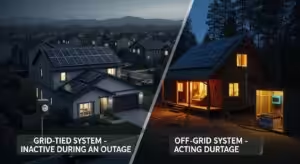
A home battery stores solar power for evenings and keeps essential circuits running during outages. In Rhode Island in 2026, the Energy Storage Rebate and ConnectedSolutions payments make batteries far easier to justify than a few years ago. A battery makes the most sense if you have frequent outages, work from home, rely on a well pump or medical equipment, or want to get more value from the solar you produce. Learn more in our guide to home battery backup systems in Rhode Island.
Keeping Your System Performing
Solar systems need very little care, but a few habits protect your investment:
- Check your monitoring app monthly. Panel-level monitoring shows right away if one section stops producing.
- Let rain and snow do the cleaning. In Rhode Island, panels rarely need washing. Never climb on the roof to clear snow.
- Watch for shade growth. Trees grow, and a few new branches can cut production. Trim when needed.
- Call your installer, not a stranger. Use the company that installed the system for service so your workmanship warranty stays intact.
Our solar panel maintenance guide goes deeper.
Frequently Asked Questions
Is solar still worth it in Rhode Island without the federal tax credit?
For many homes, yes. The Rhode Island REF grant, net metering and high local electric rates still produce solid payback on a well-designed system. The answer depends on your roof, shade and usage, which is why a real site visit matters. See is solar worth it in RI, MA and CT.
How much does solar cost in Rhode Island?
Cost depends on system size, equipment, roof condition and any electrical upgrades. Our Rhode Island solar cost guide covers the factors, and a site visit gives you real numbers for your home.
How long does it take to go solar in Rhode Island?
Plan on a few months from signing to permission to operate. Installation itself usually takes one to three days. The rest is the grant approval, permits and utility interconnection.
Can I get the REF grant if I lease my panels?
No. For homeowners, the REF Small Scale grant requires that you own the system through a cash purchase or a loan.
Do I need a new roof before going solar?
Not always, but if your roof has less than 10 to 15 years of life left, replacing it first usually saves money over the life of the system. A local company that does both can give you an honest answer.
Get a Free Rhode Island Solar Consultation
Sunfinity Power and Roofing is a local Rhode Island company that installs solar, roofs and home batteries, and handles the permits, Rhode Island Energy paperwork and REF grant application for you. To see what solar would do for your home, request a free solar savings report or schedule a consultation. We will look at your roof, your bills and the incentives you qualify for, and give you real numbers before you decide anything.