
By the Sunfinity Power and Roofing Team
For most New England homes with solar, a battery is the better first choice for backup power, and a generator makes sense as an add-on when you need to ride out multi-day outages with heavy loads. A battery switches on automatically, runs silently, needs almost no upkeep, recharges from your own panels and earns money in utility programs the rest of the year. A standby generator can run for days as long as it has fuel, which matters during a long ice storm when cloudy skies and snow-covered panels limit solar recharging. If your home has well pumps, electric heat, medical equipment or a family that cannot go without power for several days, a hybrid setup with solar, a battery and a generator gives you the most complete protection.
This guide compares the options, explains how a generator and a solar battery work together safely, and covers sizing, fuel, safety and incentives for Rhode Island, Massachusetts and Connecticut homes.
The Short Answer: Which Backup Option Fits Your Home?
Most homes fall into one of three categories:
- Solar plus battery only: best for most homes on town water with gas or oil heat, where outages usually last hours to a day or two. You keep the fridge, lights, internet, furnace blower and outlets running, and the panels refill the battery each day the sun comes out.
- Generator only (with or without solar): works for homeowners who want long runtime for the lowest equipment count and do not care about daily savings, quiet operation or utility programs. Solar without a battery still shuts off during an outage, so the generator does all the work.
- Solar plus battery plus generator: best for rural homes on wells, all-electric homes with heat pumps, households with medical needs, and anyone who has lived through a week-long outage and never wants to again. The battery handles short outages on its own, and the generator steps in only when the battery runs low.
If you are not sure where you fit, our guide to what happens to solar panels during a power outage covers the basics of grid-tied systems and backup first.
Why Solar Alone Will Not Keep the Lights On
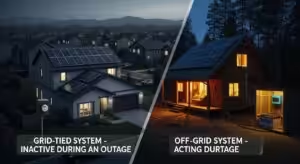
Many homeowners are surprised to learn that a standard grid-tied solar system shuts down when the grid goes down, even on a sunny day. This is a safety feature called anti-islanding. Your inverter must stop sending power out to the street so that line crews repairing damaged wires are not hit by electricity flowing backward from your roof.
To use solar during an outage, your home needs equipment that disconnects it from the grid and keeps voltage steady, which is the job of a battery system or, in some designs, a generator. The real question is how much backup you want and for how long. For more on why your inverter type matters for backup, see our guide to string inverters and microinverters.

Battery vs Generator: Side-by-Side Comparison
| Factor | Solar + Battery | Standby Generator |
|---|---|---|
| How it starts | Automatic, usually so fast that most electronics stay on | Automatic with a transfer switch, typically after a short delay of several seconds |
| Runtime | Limited by battery capacity, extended each day the panels recharge it | As long as fuel lasts; natural gas lines can run for days |
| Fuel | Sunlight and stored grid power | Natural gas, propane, diesel or gasoline |
| Noise | Silent | Noticeable engine noise while running |
| Emissions | None on site | Exhaust, including carbon monoxide; must sit outdoors away from openings |
| Maintenance | Minimal; software updates and occasional checks | Regular oil, filters, spark plugs, battery and scheduled exercise runs |
| Value when the grid is up | Stores solar, supports time-of-use savings, earns utility program payments | None; it sits idle until an outage |
| Heavy loads (well pump, central AC) | Possible with enough capacity and the right inverter, may need load management | Handles large loads well if properly sized |
| Incentives | RI rebate, plus utility programs in RI, MA and CT | Generally none |
Where batteries win
Batteries are the clear choice for everyday value. They work every day, not just during storms. In Rhode Island, a battery enrolled in ConnectedSolutions earns payments for helping the grid on hot summer afternoons. Batteries also store your midday solar for use in the evening, which becomes more valuable as utilities move toward time-based pricing. You can read more in our solar battery storage guide.
Where generators win
Generators win on raw endurance. A battery holds a fixed amount of energy. After a nor’easter, panels can be covered in snow and skies can stay gray for days, so daily recharging may be small. A generator connected to a natural gas line, or to a large propane tank, keeps going as long as the fuel lasts. Generators also handle big motor loads such as deep well pumps and central air conditioning without much special planning.
How Solar, a Battery and a Generator Work Together
A hybrid backup system is not just three products sitting in the same basement. The equipment has to be designed to cooperate, or it can trip offline, waste fuel or even damage the generator. Here is how a well-designed system behaves during a long outage.
A typical outage, step by step
- The grid goes down. The battery system detects the loss and isolates your home from the utility lines, then keeps your backed-up circuits powered.
- Solar keeps producing. With the battery holding the home’s power network steady, the panels keep making electricity during daylight. Extra solar recharges the battery.
- The battery runs low. If several cloudy days drain the battery to a set level, the system signals the generator to start.
- The generator recharges and carries the load. The generator powers the home and refills the battery, then shuts off once the battery reaches a target level. This avoids running the engine for hours at a light, inefficient load.
- The grid returns. The system reconnects to the utility, the generator stays off, and solar goes back to normal grid-tied operation and net metering.
Why compatibility matters
Not every battery system accepts a generator, and those that do have specific rules about generator size, type and wiring. Some battery systems have a dedicated generator input. Others connect the generator through a separate transfer switch. Solar output also has to be controlled while the generator is running so that solar power does not flow back into the generator, which it is not designed to accept. These details are set by each equipment maker’s installation instructions, so the battery, inverter and generator should be chosen together as one design rather than bought separately and connected later.
Adding a generator or battery to what you already have
Both upgrades are often possible. A battery can take over short outages so an existing generator runs less, and a generator can be added to many battery systems for extended outages. Plan for an electrical review first, since your main panel may need work. Our article on electrical panel upgrades for solar explains what installers look for.
Sizing Your Backup: How Much Power Do You Really Need?
Good backup design starts with your home’s loads. Two numbers matter: power (how much you need at one moment, measured in kilowatts) and energy (how much you use over time, measured in kilowatt-hours).
Step 1: List your must-have loads
Write down what you truly need during an outage. A common essentials list includes:
- Refrigerator and freezer
- Furnace or boiler controls and blower (yes, oil and gas heat need electricity to run)
- Well pump and pressure tank, if you are not on town water
- Sump pump, especially in spring and during heavy rain
- Lights in key rooms, phone charging, internet and modem
- Medical devices such as oxygen concentrators or CPAP machines
- Garage door opener and security system
Step 2: Decide between partial and whole-home backup
Partial backup puts your essential circuits on a dedicated backup panel. It needs less battery capacity or a smaller generator, and it stretches runtime. Whole-home backup powers everything, which is more convenient but needs more equipment and more careful management of large loads like central air, electric ranges, dryers and EV chargers.
Step 3: Plan for winter, not summer
In New England, the outages that last longest tend to come from winter storms and ice that bring down trees and lines. Those are also the days with the shortest sunlight and the most snow cover on panels. If your heating depends on electricity, size your backup for a cold, dark week. Homes that have switched to heat pumps should read our guide on pairing solar with heat pumps, because heating load changes the backup math significantly.
Example backup plans by home type
| Home profile | Typical goal | Suggested approach |
|---|---|---|
| Suburban home, town water, gas heat | Keep essentials on through a 1 to 2 day outage | Solar plus one battery on a partial backup panel |
| Rural home on a private well, oil heat | Running water and heat through multi-day storms | Solar plus battery sized for the well pump, with a generator for long outages |
| All-electric home with heat pumps and an EV | Heat and comfort through a winter outage | Solar plus multiple batteries with load management, generator strongly recommended |
| Home with critical medical equipment | No interruption, ever | Battery for instant switchover, generator for unlimited runtime |
| Home that rarely loses power | Everyday savings with some peace of mind | Solar plus battery, enrolled in a utility program |
Our solar system sizing guide covers how to read your usage from your electric bill, which is the same starting point for sizing backup.
Generator Types and Fuel Choices in New England
If a generator is part of your plan, the type and fuel make a big difference in convenience and safety.
Permanent standby generators
A standby generator is installed outdoors on a pad, wired to your home through an automatic transfer switch, and connected to a fixed fuel supply. It starts on its own when the power fails and can be sized for essential circuits or the whole house. This is the type that pairs best with a solar battery system.
Portable generators
Portable generators cost less and can be moved, but they must be started by hand, refueled often and run well away from the house. They should only connect to your home’s wiring through a properly installed transfer switch or interlock. Check battery compatibility before planning to pair one with a portable unit.
Fuel options
- Natural gas: the most convenient fuel where a gas line is available, since there is nothing to refill. Many rural parts of Rhode Island, Massachusetts and Connecticut do not have gas service.
- Propane: common in rural New England. Runtime depends on tank size, and deliveries can be delayed during a widespread emergency, so keep the tank topped up before storm season.
- Gasoline: mostly for portable units. It needs frequent refueling and goes stale in storage, and gas stations may lose power in a big outage too.
Safety and Code Requirements You Cannot Skip
Never backfeed the grid
Plugging a generator into a wall outlet or wiring it to your panel without a transfer switch can send electricity back onto utility lines, which can kill line workers and neighbors. Eversource’s generator safety guidance states that generators of any size should be installed by a licensed electrician and connected through a transfer switch. Solar batteries handle this automatically through their own disconnect equipment, which is one reason they are simple to live with.
Carbon monoxide is the biggest danger
Generator exhaust contains carbon monoxide, an odorless gas that can kill quickly. The U.S. Consumer Product Safety Commission advises that portable generators run outdoors only, at least 20 feet from the house, with the exhaust pointed away from the home, and never inside a home, garage, basement, crawlspace, shed or on a porch, even if doors and windows are open. CPSC also recommends battery-operated or battery-backup carbon monoxide alarms outside sleeping areas and on each floor of the home, tested monthly. Read the full CPSC generator safety sheet before running any generator. Standby units also need proper clearance from windows, doors and vents according to the manufacturer and local code.
Permits and inspections
Solar, batteries and standby generators all require permits and inspections in Rhode Island, Massachusetts and Connecticut. A generator may need both electrical and gas or fuel permits, and some towns have rules on placement, setbacks and noise. Batteries have their own fire code requirements for where they can be mounted. A licensed installer pulls the permits and coordinates inspections so your system is legal, insurable and safe.
Paying for Backup Power in 2026
The incentive picture is very different for batteries and generators, and it changed this year.
The federal tax credit ended for homeowners
The federal residential clean energy tax credit (Section 25D), which used to apply to home solar and batteries, ended after 2025. Homeowners who install solar or storage in 2026 cannot claim it. Our article on what happened to the federal solar tax credit explains the change and what it means for your payback.
Rhode Island incentives for solar and storage
Rhode Island still offers meaningful state and utility support:
- REF Small Scale solar grant: $1.65 per watt up to $14,500 for owner-owned systems. The project must be approved before installation, have a total solar resource fraction (TSRF) of 80% or higher, and be net metered.
- RI Energy Storage Rebate: $250 per kWh of battery capacity up to $8,000, with higher amounts for income-eligible households. Enrollment in ConnectedSolutions is required.
- ConnectedSolutions: Rhode Island Energy calls on enrolled batteries during summer peak events from June through September and pays participants after the summer season.
- Tax exemptions: residential renewable energy systems placed in service after 2015 are exempt from property tax (R.I. Gen. Laws 44-3-3(a)(48)), and qualifying equipment is exempt from sales tax (44-18-30(57)).
See our full Rhode Island solar incentives guide for details, and our Rhode Island home battery backup guide for battery-specific planning.
Massachusetts and Connecticut
Massachusetts and Connecticut also have programs that support home batteries, including utility programs that pay battery owners for help during peak demand. Program rules and payment levels change, so we confirm the current options for your address during your consultation. Our article on how home batteries earn money in Massachusetts explains how these programs work.
Will utility programs drain my battery before a storm?
Summer peak events are about grid demand, not storms. Most battery systems let you set a backup reserve, so a portion of the battery stays available for outages even during program events. Ask your installer how the reserve is set for your system, and raise it before a big storm is forecast if your system allows it.
Checklist: Choosing Your Backup Strategy
- How long do your outages usually last, and what was the longest one in the past ten years?
- Are you on a private well or town water?
- Does your heat depend on electricity (heat pump, electric baseboard, or the controls and blower of an oil or gas system)?
- Does anyone in your home rely on powered medical equipment?
- Do you have natural gas service, or would a generator need propane?
- Is your roof in good shape for solar, and is your electrical panel ready?
- Do you want backup that also lowers your bills and earns program payments?
- Do you have space outdoors for a generator with proper clearances, and space indoors or outside for batteries?
Frequently Asked Questions
Is a battery or a generator better for backup power?
For most New England homes, a battery is the better everyday choice because it is silent, automatic, low maintenance and earns value year-round. A generator is better for long outages with heavy loads. Many homes that need maximum resilience use both.
Can I connect a generator to my solar panels?
A generator connects to your home’s electrical system, not directly to your panels. In a properly designed hybrid system, the battery and inverter coordinate the solar, the generator and the home’s loads. The equipment must be compatible, and the solar output has to be managed while the generator runs.
How long can a solar battery power my home?
It depends on battery size, what you are powering and how much sun you get. Running only essentials stretches a battery much further than running the whole house. With solar recharging each day, a well-sized battery can support essential loads through many outages. Long stretches of cloudy, snowy weather are when a generator becomes valuable.
Can I add a battery if I already have a whole-home generator?
Often, yes. A battery can cover short outages instantly and quietly, so your generator runs less. An installer needs to review your panel, transfer switch and generator to design the right connection.
Can I still get the federal tax credit for a battery?
No. The federal residential clean energy credit ended after 2025. Rhode Island homeowners can still use the state storage rebate and ConnectedSolutions, and Massachusetts and Connecticut have their own battery programs.
Get a Free Backup Power and Solar Consultation
The right backup plan depends on your home, your loads and how much risk you are willing to live with. Sunfinity Power designs and installs solar and battery systems for homeowners across Rhode Island, Massachusetts and Connecticut, and we will help you decide whether a battery, a generator or both fits your home. We will review your usage, check your roof and electrical panel, and walk you through the incentives available at your address.
Start with a free solar savings report to see how solar and storage could work for your home, or schedule a free consultation with our team today.